
Beard oil vs balm vs moisturiser comes down to the job you need done: caring for the skin underneath, making beard hair easier to manage or keeping stray hairs in place. One suitable product may be enough. Your existing facial moisturiser may already cover the skin-care step.
Choose the result before the format. If an extra product has no clear purpose, leave it off the list for now. A longer beard does not automatically need a larger kit.
In this guide
Beard oil vs balm vs moisturiser: three different jobs
Start with the need in the left column, then read the actual product label. This is a decision aid based on intended use, not a comparison of products RENVERE has tested.
| Your priority | Useful starting point | Question for the label |
|---|---|---|
| Skin comfort beneath the beard | A suitable moisturising product, which may be your existing facial moisturiser | Does it suit your skin and can you apply it through the beard? |
| Conditioning grown beard hair | Beard conditioner or oil chosen with your skin needs in mind | What are the application, rinse-out or leave-in directions? |
| Keeping stray hairs in place | A product explicitly offering styling hold | What hold and finish are actually described? The word balm is not enough. |
Make the underlying skin part of the choice

The American Academy of Dermatology’s healthy-beard guidance suggests beard conditioner for acne-prone skin, beard oil for normal to dry skin, and a fragrance-free, non-comedogenic moisturiser for sensitive skin. These are starting points; the specific formula and your tolerance still matter.
After washing, apply the chosen moisturising product as directed, reaching the skin beneath the beard. With beard oil or conditioner, the AAD advises starting sparingly to avoid a greasy appearance. A universal number of drops would ignore different formulas and beard lengths, so follow your product’s instructions.
Check whether a conditioner is meant to be rinsed out or left in. Follow those directions even when the product name sounds familiar.
Two situations that lead to different purchases
Comfortable skin, a few stray hairs. Your need is styling rather than another promise of skin hydration. Look for a stated level of hold and a finish you would like. An oil may be marketed for conditioning, but that does not establish that it will keep a particular style in place.
Dry-feeling skin beneath short stubble. Start by reviewing your wash and suitable moisturising care. If your current facial moisturiser is comfortable and reaches the skin, ask what a separate beard product would contribute. Buying a balm simply because you have grown stubble does not answer the skin-care question.
These examples organise a cosmetic decision. Irritation, a rash or ongoing soreness calls for a different response from choosing between finishes.
Read beyond oil, balm and cream
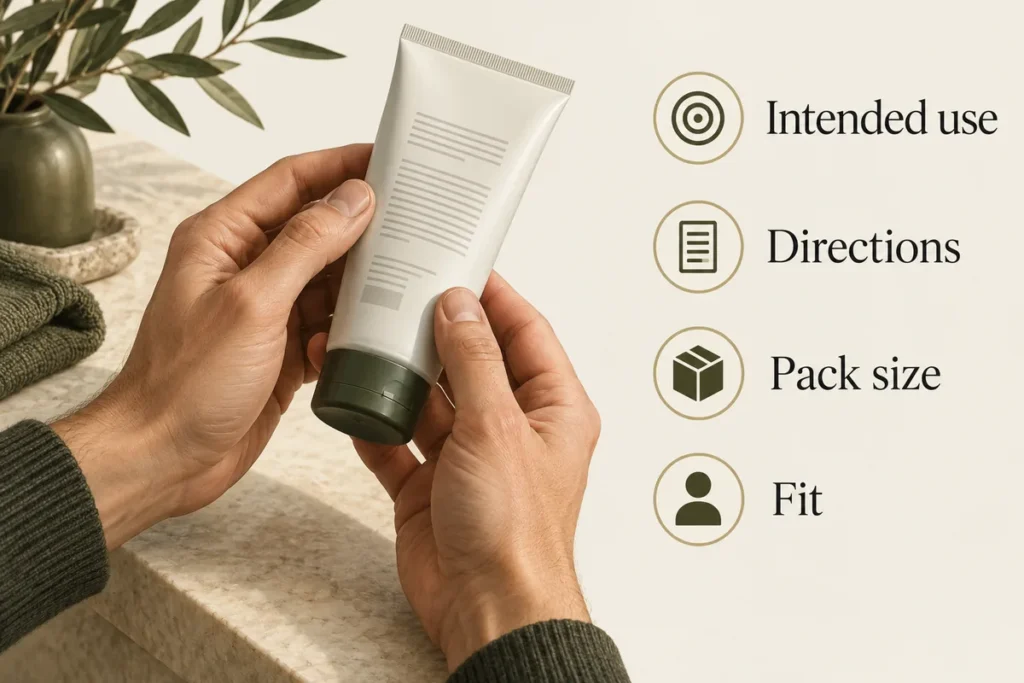
“Balm” is a commercial format name, not a standardised promise of hold. Products can be sold for conditioning, styling or both. Read the description and directions rather than assuming that every tin behaves alike. An oil format is equally unable to establish suitability for every skin type.
A moisturiser may be useful for your skin while adding little styling control. If skin comfort was your aim, judge it on that basis. Moisturising, shaping and growing a beard are separate claims.
This comparison does not provide evidence that any of these formats increases beard growth. Do not make a growth claim the deciding reason to buy without appropriate evidence.
Build a smaller, more useful shopping list
Compare intended use, skin-type guidance, fragrance where relevant, instructions and pack size. Look at how much you would need to commit to, rather than assuming a premium price or a coordinated set means better suitability.
Try to keep one distinct job for each step. If two containers make essentially the same promise, you may not need both. Keep the rest of your optional routine simple when introducing something unfamiliar, and retain the label so you can revisit its directions.
Note what you wanted, what you used and whether the finish suited you. That can guide your next choice, but cannot prove an ingredient’s effect.
When another layer is not the answer

Stop using a product that irritates you. Persistent, recurrent or severe symptoms deserve professional advice, as the NHS explains in its contact-dermatitis guidance. Itching, scaling, soreness or a rash does not automatically establish that diagnosis, and adding oil over discomfort does not explain its cause.
If bumps appear around shaved edges, adjust shaving when bumps are the concern. For a broader starting point, find a care step for your concern.
Sources and further reading
Created by RENVERE. Sources reviewed 31 October 2026. General care guidance; seek qualified advice for persistent or concerning symptoms.