

An itchy flaky scalp can send you back to the shampoo aisle before the last bottle is finished. Before buying again, check what has changed, how you use your products, and whether the symptoms need professional attention. Flaking alone cannot tell you which shampoo to choose.
You do not need to identify a condition before asking for help. A description of the symptoms, a product name and a rough timeline give a pharmacist or clinician something specific to work with. Use the checks below to put that information together.
In this guide
1. Describe the flakes without diagnosing them
Start with a short description: when the itching appears, where you notice flakes, and whether anything feels sore. Avoid repeatedly picking at the area to investigate it. A useful note records what happened, not what you think a condition must be.
The NHS explains that dandruff can make the scalp feel dry and itchy. It is not caused by poor hygiene, and several skin conditions can produce flaking. That is why a simple dry-versus-oily checklist cannot confirm the cause.

2. Review what changed before adding anything
List recent changes: shampoo, conditioner, styling products, hair dye or how you use them. Keep the packaging. A clear product name and a rough timeline are more useful in a consultation than describing everything as a sensitive-scalp formula.
Contact dermatitis can follow exposure to an irritant or allergen. Stop using a non-essential cosmetic if it irritates you, and ask a pharmacist or clinician for advice. Do not keep testing new oils or exfoliants on an already uncomfortable scalp. Follow your prescriber’s advice for medicines.
A useful question is: “This started after I changed this product; what should I check next?” That leaves room for another explanation. A timing connection is useful information, but it does not prove which ingredient is responsible.

3. Read the label before choosing a shampoo
If dandruff is the issue, a pharmacist can help you choose an appropriate anti-dandruff shampoo. Compare the active ingredient, intended use, contact time and frequency. Check the actual product available in your country: an American ingredient list is not a European shopping checklist.
The American Academy of Dermatology advises applying dandruff shampoo to the scalp and following the bottle’s directions. Some formulas need time before rinsing, but there is no single contact time for every shampoo. Do not copy another person’s schedule or assume a stronger wash will work faster.
Before paying, check that you can realistically follow the directions. An unclear label is a reason to ask a question, not to improvise. There is little value in comparing bottle sizes before understanding what you are choosing.

4. Care for your hair while addressing your scalp
Your scalp and hair lengths have different jobs in this routine. AAD recommends directing shampoo at the scalp and using conditioner after washing. For fine or straight hair, conditioner belongs on the ends; dry or curly hair may need it through the lengths.
Choose washing frequency around your hair type, oiliness and the treatment instructions, rather than a universal daily-wash rule. Absorb water gently with a towel instead of vigorous rubbing. If the ends feel rough, review that separately from the scalp symptoms. Our fine-hair conditioner guide explains placement without adding unnecessary products.

5. Set a review point and know when to ask for help
The NHS recommends seeing a GP if dandruff symptoms persist after at least four weeks of anti-dandruff shampoo. Seek advice sooner for severe dandruff, a very itchy, red or swollen scalp, or flaky patches elsewhere. Painful or concerning changes also deserve assessment; do not wait simply to finish a bottle.
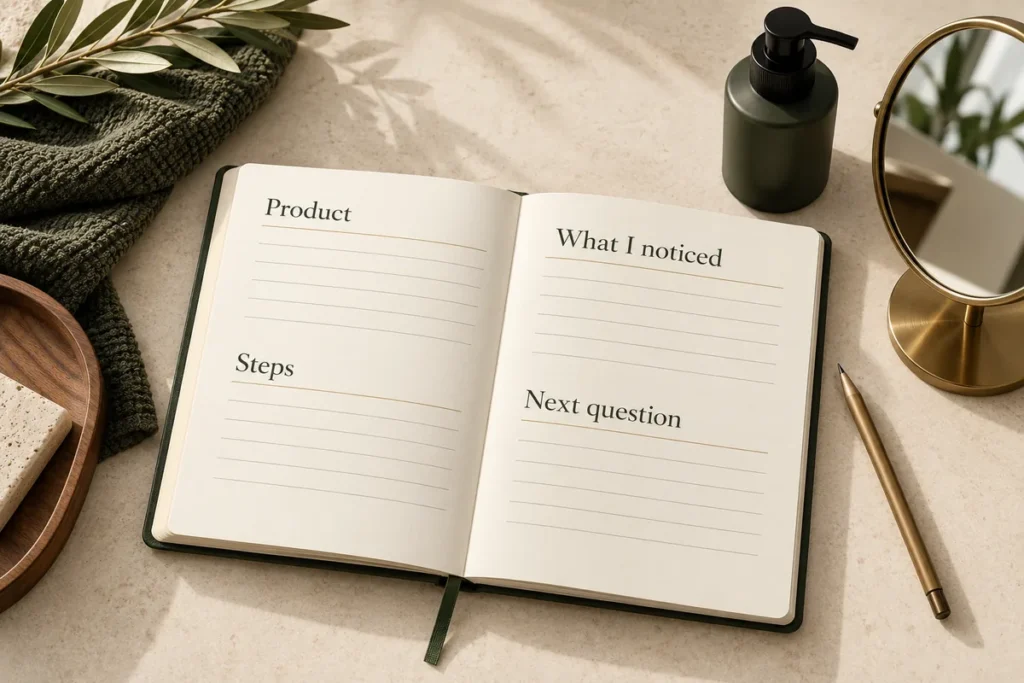
Take a brief record to that conversation. Use it to explain what you tried, not to score yourself or prove a diagnosis. This small preparation step can make the next recommendation more specific to your situation.
You do not need a perfect diary. Three clear notes are enough to organise the discussion. If the next step is professional advice, pause the shopping comparison and spend that attention on explaining the problem clearly.
| Record | Keep it simple |
|---|---|
| What you notice | Itching, flakes, soreness and where they occur |
| What you used | Product name and the label directions followed |
| What changed | Timing, comfort and questions for the pharmacist or clinician |
Sources and further reading
For shorter answers, visit our hair and scalp FAQs. For a broader starting point, try the routine finder; it does not diagnose scalp conditions.
Created by RENVERE. Sources checked 1 November 2026. General care guidance, not individual medical advice. The images illustrate care habits and do not demonstrate a diagnosis or treatment result.